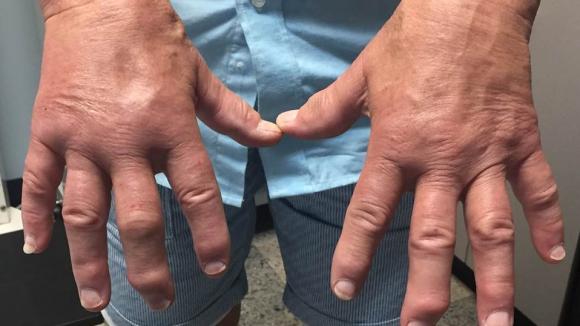
Autoimmune hepatitis (AIH) is a chronic, progressive inflammatory liver disease driven by autoimmune mechanisms, characterized by elevated serum aminotransferases, hypergammaglobulinemia, and interface hepatitis on histology.

All News
A retrospective US administrative claims cohort study of RA patients on tumor necrosis factor inhibitors (TNFis), non-TNFi biologics, or Janus kinase inhibitors (JAKis) found a statistically significantly higher risk of incident cancer in patients receiving rituximab, abatacept, or JAKis (compared with TNFis).
The American Gastroenterology Association has published its revised clinical practice guidelines for the prevention and treatment of hepatitis B virus (HBV) reactivation in at-risk patients, particularly those with immune-mediated disease, receiving immunomodulatory therapy and steroids.
Despite the advances in the treatment of PsA with biologic (bDMARD) and targeted synthetic (tsDMARD), less than half of patients with this condition achieved remission or low disease activity. Combination DMARD treatment is often used in order to achieve remission or minimal disease activity. The standard practice is to use a conventional synthetic (csDMARD) with a bDMARD. The use of the combination of bDMARD with a tsDMARD such as a JAKi or TYK2i is a new order in the treatment of PsA.
Analysis of a Greek Psoriatic Arthritis (PsA) cohort shows that nearly one quarter of patients have axial involvement, and among them, ∼30% have isolated spinal axPsA and nr-axSpA, respectively.
Dr. Jack Cush reviews the news and journal reports from last week on RheumNow.com
Dr. Jack Cush reviews highlights, trends and novel studies from EULAR 2025 in Barcelona from last week.
JAK inhibitors have taken a beating over the last three years. The excitement and potential has been tempered by mounting cardiovascular safety concerns, but specifically in at-risk patients, compared to TNF inhibitors. So it is an intriguing idea to pair JAK inhibitors with something that might have a cardioprotective effect. It is therefore worth excitement that we have a therapeutic option to follow which does just that. At EULAR 2025, we have seen phase 2 results for CPL’116, and a simultaneous publication in The Lancet Rheumatology.
Saturday was the final day of EULAR, and included several lectures, but mostly late breaking abstracts and new EULAR guidelines - notably on Rheumatoid Arthritis and another on Interstitial Lung disease in connective tissue disorders. My favorite presentations included the following.
At EULAR 2025, Dr. Laura Coates (Oxford) took the plenary stage to reframe how we think about treating psoriatic arthritis. The message was clear: in 2025, PsA treatment is no longer about following a linear algorithm; it’s about understanding the unique constellation of domains, comorbidities, and patient factors that shape each clinical decision.