Pregnancy for patients with lupus has long been considered high risk and associated with both medical and obstetric complications, but outcomes have improved over the last 2 decades and continue to improve. The large decline in in-hospital maternal mortality was greater for lupus pregnancies than for non-lupus pregnancies. Findings from a retrospective cohort study are published in Annals of Internal Medicine.

All News
Editor's note: July 1 - 5, RheumNow is running the best of the EULAR 2019 meeting. At EULAR 2019, Madrid, several recommendations including RA, SLE, and Sjogren’s syndrome have been developed. Agreement for principles with respect to the treatment of immune mediated adverse events from cancer immunotherapy are lacking.
Editor's note: July 1 - 5, RheumNow is running the best of EULAR 2019 meeting. Hydroxychloroquine (HCQ) will decrease SLE flares improve lipids, decrease clots, improve survival, augment the response to mycophenolate and are the cornerstone of treatment as per the SLE EULAR gui
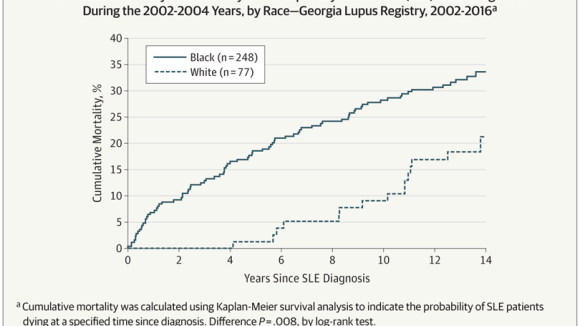
MMWR has published the outcomes from the Georgia Lupus Registry between 2002 and 2016, finding that black women were not only more likely to die from lupus than white lupus patients; but they died on average 13 years earlier (mean age 51.8 and 52.3 years, respectively) than whites (mean age 64.4 and 65.0 years, respectively).
Black women with lupus were 3.34 times more likely to die than black women in the general population, while white women with lupus were 2.43 times more likely to die than white women in the general population. None of the white women with lupus died within 5 years of diagnosis, while mortality was elevated for black women from the date of diagnosis on.
It is estimated that up to 50% of patients with idiopathic inflammatory myopathy will be complicated by interstitial lung disease, and having ILD may impart a poor prognosis. A recent review of the Johns Hopkins myositis-related ILD cohort has shown that azathioprine and mycophenolate mofetil use is associated improved lung function and less prednisone use.
Minority groups in the U.S. have differing rates of Sjögren's syndrome and exhibit distinct clinical patterns of the disease, a large cross-sectional study revealed.
The percentage of American Indians in a SS cohort of 610 patients was much higher than expected, at 25.3%, whereas the percentage of African Americans was lower, at 3.1%. In addition, American Indians had higher levels of disease activity and more extraglandular manifestations, whereas African Americans had a symptom pattern associated with subsequent lymphoma development, researchers reported in Arthritis Care & Research.
A large study of UK family practice patients shows that polymyalgia rheumatica (PMR) or giant cell arteritis (GCA) patients treated with glucocorticoids are at an increased risk of bacterial, viral, parasitic and fungal infection, even at daily doses of less than 5 mg prednisolone.
Patients with SLE are at increased risk for HF, not just of MI and stroke, with risk similar to that of patients with diabetes, researchers found in an analysis of Medicaid data.
A better understanding of rheumatic immune-related adverse event phenotypes beyond inflammatory arthritis has been furthered by work from three abstracts presented at EULAR 2019 in Madrid.
Hydroxychloroquine (HCQ) will decrease SLE flares improve lipids, decrease clots, improve survival, augment the response to mycophenolate and are the cornerstone of treatment as per the SLE EULAR guidelines presented at EULAR 2019 in Madrid and also published in ARD.
EULAR 2019 begins today in Madrid and features over 2000 presentations. After an initial review of titles and abstracts, I’ve compiled a hit list of presentations of interest to me and hopefully other practicing rheumatologists.
Reuters has reported that Mallinckrodt Plc has tentatively agreed to pay $15.4 million to resolve a US Justice Department investigation into company promotional practices for Acthar gel.
Dr. Jack Cush presents the news and best of rheumatology and medicine from the past week on RheumNow.com
Rituximab (Rituxan) may be an option for maintenance therapy in patients with difficult-to-treat systemic lupus erythematosus (SLE), European researchers reported.
A EULAR task force has reviewed the medical literature and developed evidence-based recommendations for the management of antiphospholipid syndrome (APS) in adults. They note that a high-risk antiphospholipid antibody (aPL) profile is associated with greater risk for thrombotic and obstetric APS.
The risk of serious infectious events (SIE) with rituximab (RTX) is similar to that seen in other biologics (e.g., RA: 2% or 4.3/100PY), but with prolonged use the risk may change. Recent research says that low IgG levels, RTX induced neutropenia, prior SIE and comorbidities can significantly augment this risk.
A retrospective longitudinal single center study of 700 rheumatic and musculoskeletal diseases (RMDs) treated monitored serum immunoglobulins (at baseline and 4–6 months after each cycle), clinical outcomes and SIE over time.
Dr. Jack Cush Reviews the news and journal articles from the past week on RheumNow.com
A lupus registry from San Francisco County analyzed racial/ethnic differences in lupus manifestations and found significant differences in SLE manifestations among racial/ethnic groups. Researchers found that Blacks, Asians/Pacific Islanders (API), and Hispanics are more likely to develop severe manifestations following a diagnosis of SLE.
From their database, they identified 724 SLE patients, and identified specific features in different subgroups.
The NEJM reports a randomized placebo controlled trial of nintedanib, a tyrosine kinase inhibitor, in systemic sclerosis patients with interstitial lung disease (ILD) resulted in less pulmonary decline, but had no effect on other features of systemic sclerosis.