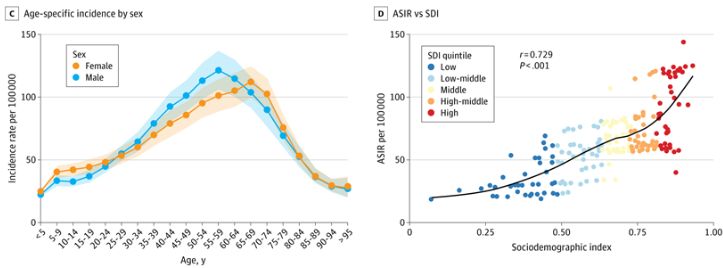
Advanced practice clinicians (APCs; nurse practitioners and physician assistants) deliver a large share of US dermatologic care, accounting for 37% of clinicians and 27% of dermatology visits by 2020. A current JAMA Dermatology reports APC drug spending trends in dermatology, with a focus on specialty medications (eg, biologics).
All News
Approximately 20 to 30 percent of all people who suffer from psoriasis also develop painful inflammation in their joints over time. If left untreated, psoriatic arthritis can lead to permanent damage to bones and joints.
Manzi et al. have published the results of the TULIP-SC trial that showed that weekly subcutaneous (SC) anifrolumab, when given to severe SLE patients, had comparable efficacy and safety to the approved intravenous (IV) anifrolumab.
Lilly announced the topline results from its phase 3b "TOGETHER PsA" trial, showing that the combination use of ixekizumab (Taltz) and tirzepatide (Zepbound) was superior to IXE alone, yielding both significant weight loss and ACR50 disease control in adults with active psoriatic arthritis (PsA).
Dr. Jack Cush reviews the news and journal articles from the past week on RheumNow.com. Who would've thunk - a PsA FMF connection? Labs to diagnose SSc-ILD? IgA-RF may be important or RZV may not work in JAK inhibitor treated patients?
EULAR has published a "points to consider" (PtCs) guidance on the development of criteria for the assessment of the disease activity in adult-onset Still’s disease (AOSD).
A large observational cohort study suggests that monitoring hydroxychloroquine (HCQ) blood levels is effective in systemic lupus erythematosus (SLE) patients with a target therapeutic range (for HCQ level monitoring) of 750-1150 ng/ml.
Dr. Jack Cush reviews the news and journal reports from RheumNow.com, including info on scleroderma, dermatomyositis and malignancy, rheumatologist and APP salary concerns.
A substantial number of patients with psoriatic arthritis (PsA), have difficult, persistent and hard-to-treat disease. A GRAPPA task force has developed a consensus terminology for two distinct states: complex-to-manage PsA and treatment-refractory PsA.
A review of patient data from the International AutoInflammatory Disease Alliance (AIDA) Network registry identifying those with mucocutaneous Behçet’s disease (BD) may progres to major organ involvement (MOI)m especially at later stages.