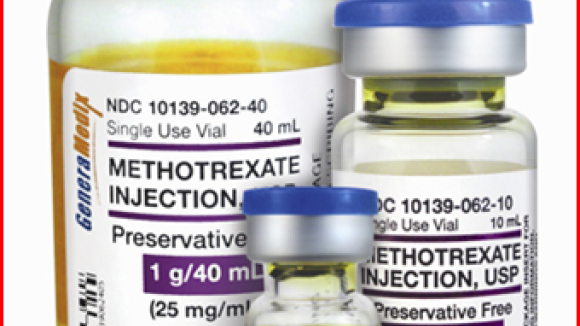
Rheumatology has a comprehensive overview of methotrexate (MTX) and the risk of lung injury, MTX-related pneumonitis and interstitial lung disease (RA-ILD) with rheumatoid arthritis (RA). Past reports suggest the frequence of MTX-pneumonitis to be between 0.3 and 11.6%; recent studies suggest it may be much lower.
All News
The antidiabetic medication canagliflozin (Invokana) lowered serum urate and reduced the risk of gout flare in a post-hoc analysis of data from two large clinical trials.
Patients with systemic sclerosis (SSc) who have persistent inflammation -- characterized by consistently elevated levels of C-reactive protein (CRP) -- have more severe disease and worse outcomes, a retrospective study confirmed.
IgG4-related disease (IgG4-RD) is a relatively new disorder since 2003, and may present as a diagnostic challenge as it can cause fibroinflammatory pathology in nearly any organ.
Dr. Jack Cush recaps standout presentations and information from ACR 2019 held in Atlanta November 9-12, 2019.
Dr. Jack Cush presents his favorite abstracts and presentations from Rheumatology Round Up and ACR 2019.
Arthritis Research & Therapy reports on a prospective cohort of children with juvenile idiopathic arthritis (JIA) shows that the incidence has held steady at 12.8/100,000 children, but that the frequency uveitis and the need for orthopedic surgery has decreased in the last 20 years.
Rheumatology has a comprehensive overview of methotrexate (MTX) and the risk of lung injury, MTX-related pneumonitis and interstitial lung disease (RA-ILD) with rheumatoid arthritis (RA). Past reports suggest the frequence of MTX-pneumonitis to be between 0.3 and 11.6%; recent studies suggest it may be much lower.
A 3 year, multicenter, European, study shows that rivaroxaban was inferior to warfarin in preventing thrombosis in patients with antiphospholipid syndrome (APS) according to the Annals of Internal Medicine. Thus despite the inconvenience of warfarin, it remains the best option for patients with APS.
A prospective analysis of newly diagnosed, inflammatory arthritis (IA) patients suggests that perceived distress (stress) increases the odds of incident IA.
Arthritis Care & Research reports that juvenile arthritis (JA) patients may have a higher risk if coronary artery disease (CAD) in adulthood.
Dr. Jack Cush delivers select commentary on select news and journal articles from the past week on RheumNow.com.
Annals of Internal Medicine reports that age-adjusted mortality rates for antineutrophil cytoplasmic autoantibody–associated vasculitides (AAV) have improved over time - with a decline of nearly 2 percent per year in the United States from 1999 to 2017. Nevertheless, long-term outcomes continue to lag behind mortality rates of the general population.
The U.S. Food and Drug Administration has approved Rituxan (rituximab) for the treatment of granulomatosis with polyangiitis (GPA) and microscopic polyangiitis (MPA) in children 2 years of age and older in combination with glucocorticoids.
This is the first approved treatment for children with vasculitis.
Dr. Jack Cush reviews the news and journal articles from the past week on RheumNow.com.
Metanalysis shows that temporal artery biopsy (TAB) for the diagnosis of giant cell arteritis (GCA) has a sensitivity of 77%, similar to results seen with temporal artery imaging. These data suggest clinicians may be willing to accept a GCA diagnosis without proof by TAB.
Obinutuzumab (Gazyva) has been granted Breakthrough Therapy Designation (BTD) by the U.S. Food and Drug Administration (FDA) for use in adults with lupus nephritis (LN). The drug made by Genentech, is going forward based on the Phase II NOBILITY study in adult patients with proliferative lupus nephritis (LN). Currently, there are no FDA-approved medicines for lupus nephritis.
The interleukin (IL)-1 receptor antagonist anakinra (Kineret) showed promise in critically ill children who develop the often-lethal condition known as secondary hemophagocytic lymphohistiocytosis (sHLH)/macrophage activation syndrome (MAS), a retrospective single-center study found.
Dr. Jack Cush reviews the news and journal articles from the past week on RheumNow.com.
Last Friday, the US Food and Drug Administration approved Ofev (nintedanib) to slow the rate of decline in pulmonary function in adults with interstitial lung disease associated with systemic sclerosis or scleroderma, called SSc-ILD.
ILD as a complication of SSc may lead to progressive loss of lung function and may be associated with a significant mortality risk. Prior to the approval of Olev, there were no FDA approved drugs for SSc-ILD.