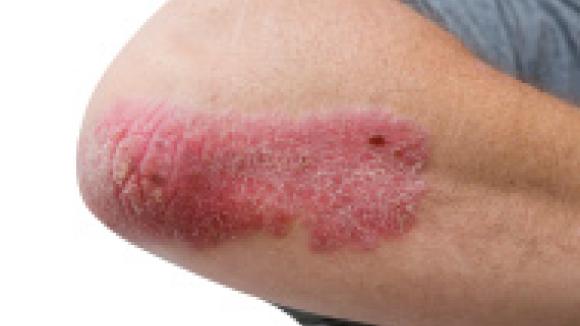
Psoriasis and psoriatic arthritis are more prevalent, often more severe, and sometimes refractory to conventional treatments in HIV-positive patients, but clinicians are understandably concerned about moving on to immunosuppressive anti-tumor necrosis factor (TNF) agents when other treatments fai

All News
Dr Jack Cush reviews this week's highlights from RheumNow.com.
Rheumatology News has a novel online report about combined rheumatology-dermatology clinics. In the last several years, there have been a few of these in operation (Boston, Chicago, Rhode Island).
From tofacitinib developmental trials in RA and psoriasis and adherence to T2T in early RA to a rheumatology pearl about dapsone and much more, here are the highlights of what you may have missed on RheumNow.com this week.
Valeant Pharmaceuticals International's experimental drug to treat psoriasis should be approved as long as certain measures are put in place to mitigate the risk of suicide, an advisory committee to the U.S. Food and Drug Administration concluded on Tuesday.
The Food and Drug Administration’s Arthritis Advisory Committee (AAC) yesterday recommended that the Sandoz etanercept (Enbrel) biosimilar (GP-2015) be approved for use in the United States.
At the EULAR 2016 meeting, new EULAR recommendations for the management of Behçet's disease (BD) were presented.
The NEJM today published the results of two phase-3 trials (UNCOVER-2 and UNCOVER-3) demonstrating the efficacy of ixekizumab (a monoclonal antibody against interleukin-17A) in the treatment of moderate-to-severe psoriasis.
In the last two years there have been increasing reports of mosquito-borne infectious arthritides. Dengue fever was best known until the introduction of viral infections due to chikungunya and Zika.
The following is a compilation of several frequently asked questions regarding tuberculosis (TB) testing or treatment in patients on a TNF inhibitor (TNFi) or other biologic agents.
Secukinumab (Cosentyx) has recently been approved for use in ankylosing spondylitis and psoriatic arthritis; the latter largely based on the FUTURE 2 and the just reported FUTURE 1 clinical trial. FUTURE 1 demonstrates the efficacy and safety of secukinumab, with inital weekly intravenous loading, given monthly as a subcutaneous injection.
Watch Dr. Cush discuss the highlights from this week on RheumNow.com.
Idiopathic inflammatory myopathies (IIMs) may be complicated with life-threatening conditions requiring intensive care unit (ICU) admission. The outcomes of such complications may be dire, but there are few series addressing the outcomes of those admitted to the ICU.
Choi and colleagues analyzed US hospitalizations (2009–2013) to assess the frequency and racial distribution of patients hospitalized with Stevens-Johnson Syndrome (SJS) and Toxic Epidermal Necrolysis (TEN) related to the use of urate-lowering (ULT) therapy (predominantly allopurinol).
Danish researchers studied a cohort of 59,423 mild psoriasis and 11,566 severe psoriasis patients over a 14 year period, and found 240 and 50 cases of abdominal aortic aneurysms (AAA), repectively. (Citation source http://buff.ly/1YxGpDA)
Dr. Jack Cush reviews the rheumatology highlights from the news, media, and journals from this past week:
Pfizer has issued a press release of its preliminary results from the OPAL study that examined the efficacy and safety of tofacitinib 5 mg and 10 mg twice daily (BID) in adults active psoriatic arthritis (PsA).
There have been several reports of psoriasis being linked to chronic renal disease in the literature. Another population-based study has also found a link between severe psoriasis and kidney disease.
Researchers at the University of Toronto have prospectively studied a cohort of 464 psoriasis patients without a diagnosis of arthritis and followed them over 8 years to estimate the incidence and frequency of psoriatic arthritis (PsA).