The American College of Rheumatology (ACR), in partnership with the Spondylitis Association of America (SAA) and the Spondyloarthritis Research and Treatment Network (SPARTAN), released the 2019 Update of the Recommendations for the Treatment of Ankylosing Spondylitis (AS) and Nonradiographic Axi

All News
Lancet reports that the selective JAK1 inhibitor, upadacitinib, was effective when given to patients with active ankylosing spondylitis.
Dr. Jack Cush recaps the news and journal reports from the past week on RheumNow.com.
A Canadian analysis shows that rheumatoid arthritis (RA) patients are more likely to receive biologic DMARDs earlier if they are younger, female, and living in urban areas closer to prescribers.
Largely because it can be difficult to do studies in pregnant women, gaps remain in the area of rheumatic disease in pregnancy. This year’s ACR highlights some important new points to consider.
Below are several of the highlight studies in psoriatic arthritis (PsA) presented at the ACR 2019 annual meeting in Atlanta.
The ACR Plenary Sessions featured some of the best research presented on Sunday, Monday, and Tuesday in Atlanta. Here are my seven notable highlights from the Plenaries.
Dr. Jack Cush reviews the news and journal articles from the past week on RheumNow.com.
Major new insights into the treatment of psoriatic arthritis dominated the headlines during the past year, with a head-to-head trial comparing IL-17A inhibition with tumor necrosis factor blockade, another study considering whether methotrexate can improve outcomes with anti-TNF therapy in PsA, and an investigation into the effects of biologic therapy on bone.
Novartis has announced the results of the EXCEED trial that pitted its IL-17 inhibitor, Cosentyx (secukinumab - SEC) against Humira (adalimumab - ADA) in patients with active psoriatic arthritis. The trial demonstrated that SEC was not non-inferior to ADA, but failed to meet its primary endpoint of superiority over ADA as far as drug efficacy.
Dr. Jack Cush reviews recent journal articles and info bits from the past week on RheumNow.com.
Arthritis Research & Therapy reports on a prospective cohort of children with juvenile idiopathic arthritis (JIA) shows that the incidence has held steady at 12.8/100,000 children, but that the frequency uveitis and the need for orthopedic surgery has decreased in the last 20 years.
Children with inflammatory diseases who were treated with tumor necrosis factor (TNF) inhibitors had a higher rate of incident psoriasis than those not exposed to these biologics, a single-center retrospective study found.
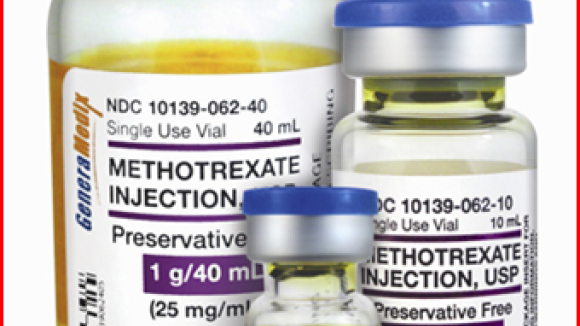
Rheumatology has a comprehensive overview of methotrexate (MTX) and the risk of lung injury, MTX-related pneumonitis and interstitial lung disease (RA-ILD) with rheumatoid arthritis (RA). Past reports suggest the frequence of MTX-pneumonitis to be between 0.3 and 11.6%; recent studies suggest it may be much lower.
JAMA has an article this week on the shift from biologic drugs to less expensive therapeutic biosimilar agents. The impact of biosimilars can be easily represented by the shift from adalimuamb - a biologic with nearly $19 billion in sales in 2018 - to any one of the four FDA approved biosimilars for adalimumab (see the daily download for slides on new adalimumab and other biosimilars).
Dr. Jack Cush reviews the news and journal articles from the past week on RheumNow.com.
Control of pain in patients with rheumatoid arthritis (RA) often focuses on control of inflammation as a means to better control pain.
A prospective study of birth outcomes to mothers exposed to adalimumab (ADA) between 2004 and 2016 was conducted by Organization of Teratology Information Specialists (OTIS) Research Center at the University of California San Diego, and showed that ADA exposure was not associated with an increase
Hand OA responds to 10mg/d Pred over 6wks. As expected symptoms return on cessation Anecdotally, there are people who do well on pragmatic, long term low dose eg 5mg or less/d #ACR19 @rheumnow Abst1760 https://t.co/FtE9vHb655
The C-AxSpand study, Certolizumab-treated nr-axSpA pts with shorter symptom duration (< 5 vs ≥ 5 years) showed greater improvements across signs and symptoms of disease and in quality of life. Kay J et al #ACR19 @RheumNow