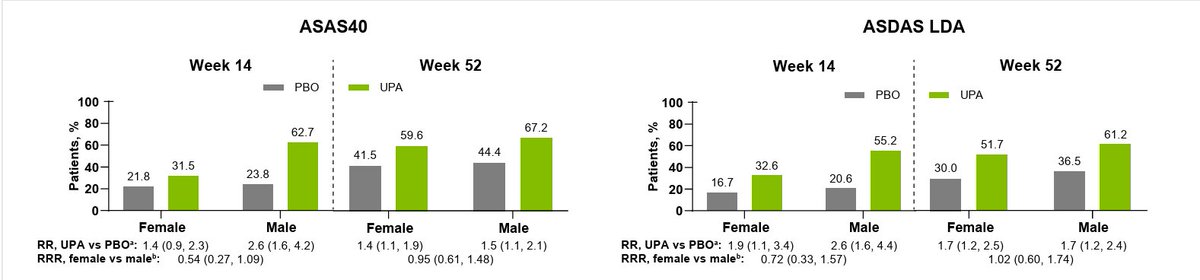
In recent years, data has emerged suggesting that female patients with spondyloarthritis, both psoriatic arthritis and axial spondyloarthritis, may have worse outcomes than male patients. A number of post-hoc analyses of randomised controlled trials of both TNF inhibitors and IL-17 inhibitors suggest that this phenomenon is also manifested in the responses to these agents; female patients do less well than male patients. The mechanisms behind this remain to be fully elucidated.

All News
Is there ‘bang for the buck’ using big data to help predict who will develop RA in at-risk populations and similarly to predict response to csDMARDs, TNFi and JAKi in RA?
Dr. Jack Cush reviews the news and info reports the day before ACR 2025
Dr. Jack Cush reviews the news and journal reports, discusses pediatric reports, pregnancy data, diet and nutrition and more.
Dr. Jack Cush reviews the news, FDA approvals, and journal articles. In this episode: HMGCR Abs, FDA approvals and Cush eats crow.
Dr. Jack Cush reviews the news, journal reports and important associations in rheumatology from the past week on RheumNow.com.
Dr. Jack Cush reviews the news and journal reports from this week on RheumNow.com. Today we cover GLP-1 agonists, acupuncture, what JAKs won’t do & an FDA Pink Slip.
JAMA has published a systematic review and meta-analysis of head-to-head studies showing there was no meaningful difference in safety events observed when taking either JAK inhibitor (JAKi) vs TNF antagonist (TNFi) therapies for the treatment of immune-mediated
The unveiling of the updated 2025 recommendations for RA treatment, presented by Josef Smolen in the plenary session on the first day of the conference, sparked attention. Although not yet formally published, these updated recommendations represent a refined consensus that simplifies decision-making while reinforcing the importance of treat-to-target principles in RA.
Dr. Jack Cush reviews the news, journal reports, FDA approvals, drug safety, and more from this week.
The third survey in this series addressed clinician views on future trends (AI), future therapies and lessons learned.