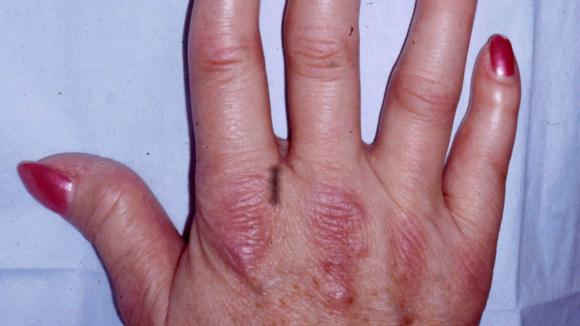
The benefits of hydroxychloroquine in lupus are many, but if you were to withdraw HCQ? A recent study of five Canadian cohorts, suggests that certain baseline variables, including age, race, and steroid use, were predictive of flare in patients with SLE who tapered or discontinued treatment with hydroxychloroquine.

All News
"If you're having trouble paying for your medications, Drug Company X may be able to help."
2020 was historic, memorable and game-changing. Under the cloud of COVID-19, there were many significant and memorable advances and setbacks for the rheumatology world. In our accounting of most read articles for 2020, (not surprisingly) 17/20 were COVID-related.
The ProDERM study design and outcomes are previewed in Medicine; and as promised the results were revealed at ACR Convergence in November 2020 showing that IVIg is safe, effective and superior to placebo i(PBO) in patients with dermatomyositis (DM).
Takeuchi et al has published their large experience with long-term tacrolimus use in lupus nephritis patients showing its real-world safety and efficacy.
The diagnosis of axial spondyloarthritis (and anklylosing spondylitis) (axSpA) is often delayed and usually not diagnosed by rheumatologists; a recent metanalysis shows that longer delays were attributable to lower education levels, younger age at onset and absence of extra-articular manifes
According to a recent report in Annals of Rheumatic Disease, public enthusiasm for hydroxychloroquine (HCQ) created significant access issues for rheumatic patients in the early phases of the COVID-19 pandemic.
UK Clinical Practice Research Datalink population study shows that patients with immune-mediated inflammatory diseases, such as RA, PMR, GCA and IBD, have an augmented risk of CV outcomes with glucocorticoid use; even lower doses had a near doubling of their underlying CVD risk.
Dr. Jack Cush reviews the news, journal articles and favorite blogs from this past week on RheumNow.com.
Recurrent pericarditis is a rare, probable autoinflammatory disorder mediated by interleukin-1 (IL-1); and is often refractory to glucocorticoids and colchicine.
Non-adherence may be the single most untold risk to suboptimal outcomes in the care of musculoskeletal disease. It has been estimated that 30-80% of patients with rheumatic and musculoskeletal diseases (RMDs) are nonadherent to prescribed regimens. EULAR has commissioned a task force
Spinal Benefits Seen With Cosentyx in PsA
Secukinumab (Cosentyx) was effective for axial manifestations of psoriatic arthritis in a 52-week multicenter phase III study, investigators reported.
Annals of Rheumatic Disease reports on an analysis of lupus (SLE) patients that shows COVID-19 infection rates were similar between those lupus patients who were taking hydroxychloroquine (HCQ) and those not taking HCQ.
JAMA has published a clinical update of recent studies on GCA. While PET/CT scanning are novel means of demonstrating activity, they have not changed the diagnostic approach to GCA or PMR and although there are no new proven treatment strategies for PMR beyond glucocorticoids, the FDA has approved tocilizumab as a first-line glucocorticoid-sparing agent.
The ACR has published guidelines to manage reproductive health issues in rheumatic disease (RMD) patients before, during and after pregnancy. In this second excerpt from their guidelines articles, we present recommendations (and good clinical practice statements) for paternal rheumatology medication use by men with RMD and on conventional rheumatology medications and biologic use in pregnancy for women with RMD.
The European League Against Rheumatism (EULAR) and the American College of Rheumatology (ACR) have jointly developed new classification criteria for systemic lupus erythematosus (SLE); prompted by the need for criteria that were both highly sensitive and specific. The net result is improved sensitivity and specificity, but the use of positive ANA requirement along with a longer list of weighted criteria ensures its utility in SLE research (including early or latent SLE), but not clinical practice.
After years of bemoaning the challenges of telemedicine, our rheumatology clinic transition entirely to a remote clinic in the space of a week. One of the few good things to come out of this crisis is that we may learn that in-person visits are not as critical as we thought, which may in turn help our specialty’s access issues. The only thing we can’t do remotely, however, are infusions.
What started out as online tweets and sharing newsfeed and case reports, has progressed to the formation of the COVID-19 Global Rheumatology Alliance, whose mission is to create an international rheumatology registry of patients affected by the disease in order to better understand the disease and guide clinicians in assessing and treating patients.
Hydroxychloroquine is one of many medications frequently used in rheumatology practice. Its remarkable versatility is attested by its routine use in lupus, in patients with an autoimmune coagulopathy, in patients with rheumatoid arthritis, as well as in those with a low-level inflammatory arthropathy.
ACIP Recommendations for Pfizer-BioNTech COVID-19 Vaccine Use (including Special Populations)
Following the FDA issuance of an Emergency Use Authorization for the Pfizer-BioNTech COVID-19 vaccine, the Advisory Committee on Immunization Practices (ACIP) issued interim recommendations for the prevention of COVID-19 in persons aged ≥16 years.