Switching biologic disease-modifying anti-rheumatic drug (bDMARD) therapy after failure of a first bDMARD for the treatment of psoriatic arthritis (PsA) can be effective, according to a review of the literature and PsA consensus treatment recommendations.
All News
Patients often characterize certain foods as “inflammatory” or “anti-inflammatory” as they combat their arthritis.
Multiple patient- and disease-related factors -- including medication use -- were associated with the development of severe infections among patients with systemic lupus erythematosus, a Spanish study found.
This appears to be the year for biologic treatments in giant cell artertis (GCA).
Biosimilar reports is an ongoing series dedicated to advances, discussions and developments in biosimilar agents intended for use by rheumatologists. Many of these items were compiled from news sources, journal articles and regulatory documents and are cited and linked within each section.
Dr. Jack Cush reviews this week's news and information from the 2017 RWCS meeting in Maui.
Baricitinib is a novel inhibitor of Janus kinases JAK1 and JAK2 that has been extensively studied in rheumatoid arthritis (RA). Baricitinib (AKA Oluminant) was recently approved by the EMA for use in Europe at a once daily dose of 4 mg per day.
As a musculoskeletal radiologist, I work every day with rheumatologists. I have been in practice for approximately 17 years and had a musculoskeletal radiology fellowship prior to establishing my practice.
FDA has approvesd the IL-17 targeted therapy Siliq (brodalumab) for moderate-severe plaque psoriasis.
The European Commission has approved Eli Lilly's rheumatoid arthritis drug Olumiant (baricitinib) for use in Europe for RA patients with moderate-to-severe active disease in adults who have not responded one or more disease-modifying antirheumatic drugs.
Articular manifestations of Crohn's disease affects a significant number of patients with either oligoarticular or RA-like polyarthritis or spondyloarthritis.
Treatment of systemic sclerosis is difficult, as there have few proven therapies capable of altering the course of the disease. Ideally, early intervention affords the optimal scenario wherein drug intervention can be proven to work.
The American College of Physicians (ACP) recommends that physicians avoid prescribing drugs, especially narcotics, for patients with acute or subacute low back pain.
New research confirms that patients with psoriatic arthritis (PsA) face significant healthcare and socioeconomic hurdles.
Since its US approval in 2012, tofacitinib has become a widely used treatment for rheumatoid arthritis (RA).
Whether you're impressed with its efficacy, or distressed with its side effects, its track record is voluminous and has been recently reviewed.
Dr. Jack Cush discusses the news and reports from this week on RheumNow:
A new study sheds important light on the long-term outcomes of children diagnosed with systemic lupus erythematosus (SLE).
Poorer and less-educated older Americans are more likely to suffer from chronic pain than those with greater wealth and more education, but the disparity between the two groups is much greater than previously thought, according to new research.
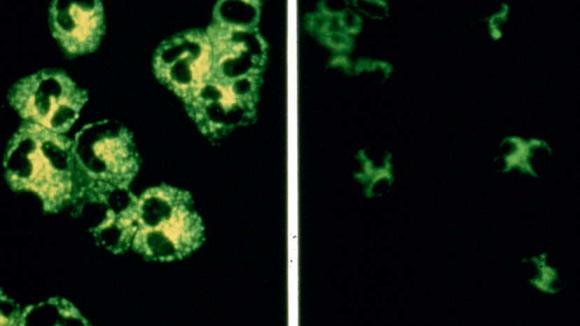
Patients known to be autoantibody positive (e.g., anti- Jo1) for the anti-synthetase syndrome were assayed by indirect immunofluorescence (IIF) for other reactivities, showing antinuclear staining (ANA) or cytoplasmic staining (Anti-Cyt Ab+).
Oligoarticular-onset juvenile idiopathic arthritis accounts for nearly half of all JIA patients. While many of these children will require DMARD therapy, many others are treated with antiinflammatory meds or intra-articular corticosteroids. But the evidence for this latter approach is scant.