
Article
The US Food and Drug Administration (FDA) has approved a new subcutaneous formulation of Benlysta (belimumab) for use in active, autoantibody‑positive Systemic Lupus Erythematosus (SLE) patients.

Search for Terms or Answers
The US Food and Drug Administration (FDA) has approved a new subcutaneous formulation of Benlysta (belimumab) for use in active, autoantibody‑positive Systemic Lupus Erythematosus (SLE) patients.

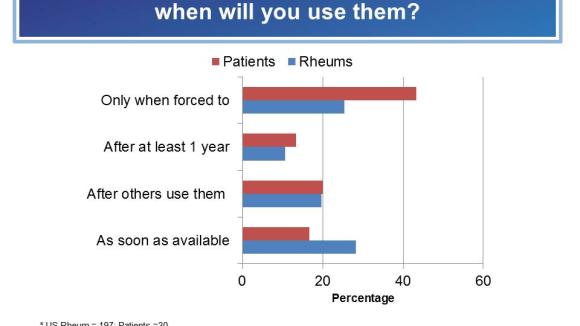
The RheumNow “Live Vote” on the use, uptake and safety of biosimilars contrasts rheumatologist and patient views. Despite FDA approval and looming introduction, there is considerable concern, knowledge gaps and hesitancy regarding their uptake in the US. The survey's primary question demonstrates that less than one-third of US rheumatologists are prepared to adopt biosimilars when they are available.
HIV infection and AIDs has been associated with numerous complications, presumably resulting from impaired immunity from infection. Sporadic cases and small cohorts of patients with rheumatic and autoimmune syndromes have been described but epidemiology data on the prevalence is scarce.

Dr. Jack Cush reviews the news from the past week on RheumNow.com:
A population-based claim study from Sweden has shown that lupus and pre-lupus patients are at risk for adverse maternal and fetal outcomes.

Investigators with the Swiss Clinical Quality Management (SCQM) program have studied the effects of obesity on patients with axial spondyloarthritis (axSpA) and, specifically, their response to tumor necrosis factor inhibitors (TNFi).

Streptococcus pneumonia is a leading cause of morbidity and mortality in adults; including patients with autoimmune diseases who are at particular risk.

It does not come as a surprise to anyone anymore that Acute Coronary Syndrome (ACS) is one of the major causes of morbidity and preterm mortality in RA. What we don’t know is what measures need to be taken to modify the risk and how effective such measures are.

A recent report in Nature Communications has studied multiple nationalities has shown a "disentangled complex HLA multigenic effect" underlying the genetic basis of systemic lupus erythematosus (SLE).

Curbside Consults are cases submitted by our rheumatology colleagues as challenging therapeutic or safety issues. Answers are based on experience, with added evidence from the medical literature and published guidelines. Here are four new cases.

Systemic lupus erythematosus (SLE) is associated with an increased risk of cardiovascular disease (CVD). The cardioprotective benefits of aspirin (ASA) are well known and the ancillary CV and diabetogenic effects of hydroxychloroquine (HCQ) have also been shown.

The U.S. Food and Drug Administration (FDA) has approved the IL-23 inhibitor, Tremfya (guselkumab), for patients with moderate to severe plaque psoriasis.

Dr. Jack Cush reviews highlights from the past week on RheumNow.com:

Systemic inflammation (from underling inflammatory polyarthritis) clearly accelerates atherosclerosis with a resultant increase risk of cardiovascular disease.

The 12 month POET study analyzed 817 rheumatoid arthritis (RA) patients who achieved remission or low disease activity (LDAS) for ≥6 months and then randomized 2:1 to stopping or continuing their TNF inhibitor.

Acute diffuse lung infiltration in patients with systemic lupus erythematosus (SLE) requires prompt evaluation for diffuse alveolar hemorrhage (DAH) when patients have low levels of hemoglobin and complement compound C4 and symptoms of hypoxia.

Among older patients using medium to high doses of the anti-inflammatory steroid prednisolone, treatment with the osteoporosis drug alendronate was associated with a significantly lower risk of hip fracture, according to a study published by JAMA.

Rituximab, a chimeric anti-CD20 monoclonal antibody, has been effectively used in the treatment of multiple autoimmune disorders for over two decades. But the response to rituximab has been shown to not be as effective in SLE as it is in RA.

Data made public by the Centers for Medicare & Medicaid Services shows that drug and device makers made nearly $8.2 billion in payments to U.S. physicians and teaching hospitals in the last year. Since 2013, CMS has been tracking physician payments as part of the Affordable Care Act.

The FDA has approved both IV and SC ORENCIA (abatacept) for the treatment of adults with active Psoriatic Arthritis.

By downloading this material, I acknowledge that it may be used only for personal use and personal education and that I will accredit RheumNow.com as the source and owner of this material. Commercial use or mass reproduction of this material without permission from RheumNow (info@rheumnow.com) is prohibited.

